
Bad Bunny's $100M empire wasn’t built on talent alone. It was built on a ruthless commitment to knowing exactly who he’s for, showing up where they are, and turning every release into a cultural moment. That same playbook is available to brands through audience-based, advanced TV ad campaigns.
Audience-first Advanced TV—where linear, local, and CTV work together—lets you grow a brand the way Bad Bunny grows fan bases: by being obsessively specific, relentlessly measurable, operationally disciplined, culturally relevant, and anchored in conviction.
Here’s how.
---
## 1. Be unapologetically specific: your niche is your superpower
Bad Bunny never tried to please everyone. He went deep on his audience—language, culture, aesthetic—until the world had to pay attention. Advanced TV campaigns are a way brands can do the same.
Long before B2B marketers started chasing niche audiences on streaming platforms, Centriply’s team was already doing audience buying on local cable at a level of precision that would make most digital teams jealous. “We’ve been doing audience buying on linear TV, especially on the cable side, for decades,” says Shelley Stansfield, Director. “We came out of political into commercial and branding because we could find, with our TV advertising technology, different small groups geographically.”
This isn’t just about targeting a city or a DMA. Centriply's ad tech, Tango Media Systems’ methodology lets advertisers reach people with staggering granularity. If a law office wants to recruit new staff, her team can target viewers down to the ZIP Code.
That level of precision is how you take a mass-reach medium and make it feel like a direct message. Like Bad Bunny speaking to his core fans first, Audience-based advanced TV campaigns let you start small, specific, and powerful—and then scale.
---
## 2. Make them come to you: prove the impact, don’t just place the ad
Cultural gravity doesn’t come from shouting louder; it comes from being so relevant that people show up on their own. For brands, that means you can’t just run TV—you have to prove it moves people to act.
Audience and location targeting is only half the battle. Proving it works is the other. Centriply demystifies TV attribution with a practical, privacy-compliant method that connects hundreds of TV impressions to a real-world outcomes.
The key isn’t identity—it’s location.
By matching where and when ads ran with where and when people show up, brands can create a measurable link between ad delivery and audience response. Instead of “we think TV worked,” you can say, “this campaign drove this outcome from this audience in these neighborhoods.”
That’s how you turn TV from a faith-based channel into a performance engine that earns its seat at the table beside search, social, and programmatic.
---
## 3. Respect the drudgery: operations are your hidden headliner
It’s easy to romanticize Bad Bunny’s creative output. What you don’t see is the machinery behind it—distribution, timing, coordination, and logistics. Audience-based TV campaigns are exactly the same.
In a world obsessed with brilliant creative, Stansfield argues that real success depends on the unglamorous side of the business: operations. This is where teams manage the messy realities, like the latency gap between a TV ad that “can take a day to upload” and a digital ad that takes three minutes.
“So few people want to do it because it’s the nitty-gritty detail, it’s the drudgery of it all,” she says. “It’s not glamorous—you’re not making the creative—but it’s so crucial. That’s operations.”
Advanced TV campaigns that actually grow brands don’t happen because someone had a clever idea. They happen because:
- Inventory is curated and kept up to date.
- Multimarket buys are coordinated, not cobbled together.
- Linear schedules and CTV placements are aligned instead of competing.
- Latency, clearances, and pacing are monitored and adjusted constantly.
It’s the invisible work that makes the visible work pay off.
---
## 4. Turn campaigns into cultural events, not background noise
Bad Bunny doesn’t just “release” projects—he creates moments. Audience-driven Advanced TV campaigns let brands do something similar: turn launches into experiences people notice, remember, and act on.
When campaigns fall short, it’s rarely because the tech can’t handle it. More often, it comes down to two very human blind spots.
The first is personal bias. Some young marketers dismiss entire channels with lines like, “Oh, nobody watches TV anymore,” ignoring the millions of households that still make up the linear TV audience. That blind spot costs reach, frequency, and incremental growth.
The second is cutting corners. Conversion tools such as using QR codes or digital watermarks get skipped because they’re seen as “extra work.”
“A lot of people say, ‘We don’t have the manpower, we don’t have the time. We’ve got to get this up by Tuesday,’” Stansfield says. “And yes, it’s a lot of work. But it matters.”
When you treat TV as a cultural moment, not just a media line item, you:
- Design creative that invites participation, not passive viewing.
- Use scannable or trackable elements to close the loop.
- Align TV flights with product drops, social pushes, and PR hits.
- Turn audiences into participants across channels, not spectators on a couch.
Advanced TV gives you the coordinates; your job is to build the moment.
---
## 5. Stand for something real: unify your screens around conviction
Bad Bunny’s fan loyalty comes from more than output—it comes from conviction. He stands for something. Audience-based Advanced TV campaigns can help brands do the same, we make them “easy placement” so planners can start making intentional choices.
We believe in the people behind brand growth—which means not just grabbing the simplest schedule—it also means analyzing which locations are best, which programming environments fit, and whether the buy should be linear, CTV, or both. CTV is finally reaching the scale and inventory needed to match what’s long been possible with linear.
“It's important to know how to put the two together,” Stansfield says, “combining the scale of local TV and the support of CTV. It’s the audience and location data that allows us to be able to find the niche that makes them both work together.”
This TV strategy doesn’t live in a silo; it powers a full-funnel, integrated campaign. Large agencies call it the “integrated department,” but in practice, it’s a data discipline:
- Layering multiple data sources, from foundational tools like LiveRamp to platform signals.
- Using performance from a LinkedIn campaign’s ZIP Code-level results to inform a TV buy.
- Finding “pockets of CIOs in places like Las Vegas” and then surrounding them across screens.
The biggest barrier isn’t technology—it’s silos. “So many of those functions are separated,” Stansfield says. “I have my social team, I have my digital team, I have my email team.”
“Bringing together traditional and CTV is going to be both exciting and terrifying because the broadcasters have so much infrastructure,” Stansfield says. All the strategy, tech, and operational lift serve a single purpose: “It’s all about feeding the information so that an advertiser can see the impact all at once.”
That’s what conviction looks like in Audience-based Advanced TV plans: not just being on every screen, but aligning every screen around a clear strategy, a defined audience, known locations, and a measurable business outcome.
---
## Build your own Bad Bunny–level brand with advanced TV
Bad Bunny built his empire by knowing exactly who he was for, showing up where they lived, and turning that focus into outsized cultural impact.
Audience-driven Advanced TV campaigns mean that brands can follow the same path:
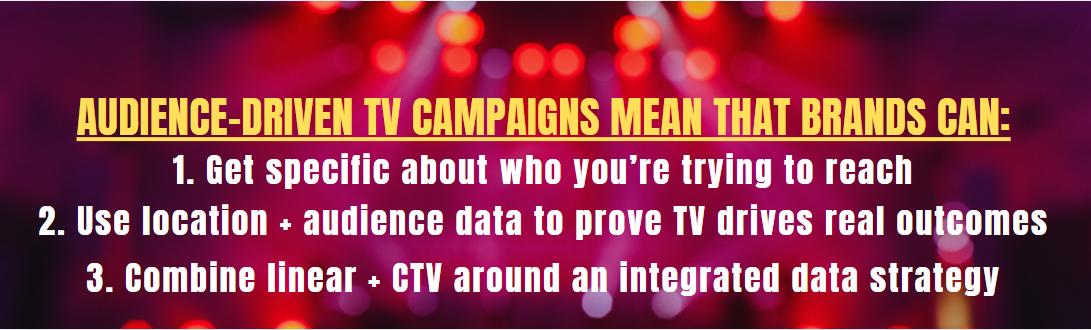
1. Get hyper-specific about who you’re trying to reach.
2. Use location and audience data to prove that TV drives real outcomes.
3. Invest in the operational backbone that makes complex campaigns possible.
4. Treat launches and flights like cultural moments, not just schedules.
5. Combine linear and CTV around a clear conviction and integrated data strategy.
When you do, TV stops being “traditional media” and becomes something much closer to what it is for fans of a global artist: the place where a relationship starts, deepens, and ultimately turns into a loyal, high-value audience that keeps showing up.