
The "big city" strategy is failing B2B advertisers. While legacy media planning suggests starting with the largest DMAs (New York, LA, Chicago), data shows that for high-value audiences like Chief Information Officers (CIOs), these markets actually under-deliver. Here's a case study.
Quick Insights for B2B Media Planners:
- The Trap: Top 6 DMAs often have an audience index below 100, meaning you pay more for less concentration.
- The Solution: Shifting to audience-first geotargeting across 2,800 local cable systems can increase audience concentration by 45% or more without increasing spend.
- Precision: Targeted ZIP Code strategies can achieve a 411 Index (4x concentration) for C-suite executives like CIOs.
The Problem with "Average" Thinking in TV Media Planning
For decades, TV ad planning followed a simple rule: Start with the biggest Designated Market Areas (DMAs). New York. Los Angeles. Chicago. Boston.
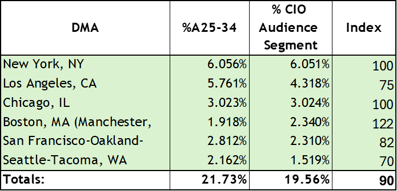
On paper, this looks like a strong national footprint. In reality, when we applied advanced audience data to locate CIOs across all 210 DMAs and 2,800 local cable systems, the "Big 6" metros failed the efficiency test.
Reality Check: The "Big 6" Performance
| Market Strategy | National Coverage | Audience Index | Result |
| Traditional "Big 6" | ~19.5% | 90 | 10% LESS audience than the national average |
| Audience-Driven Top 23 | 27.46% | 135 | 35% MORE audience concentration |
NOTE: Indexing for data-driven analysis: A 90 index means you are under-delivering your target audience while still paying premium CPMs for major metro inventory.
 The "Unstructured Data" Opportunity
High-value B2B audiences like CIOs don’t cluster neatly into top DMAs.
They are hidden across secondary markets, specific cable systems, and highly concentrated ZIP Codes.
Traditional planning—and even generalized AI—breaks down here because the data is:
Fragmented: Spread across 210 disparate markets.Non-standardized: Locked in local systems and static rate cards.
Invisible: Hard to find using broad-stroke demographic tools.
A Better Approach: Audience-First, Full-US Visibility
By integrating LiveRamp, Skydeo, and TV Optimized data, we mapped B2B executive audiences across the granular landscape of US television:
- 210 DMAs
- 2,800 Local Cable Systems
- 42,000 ZIP Codes
Case Study: Finding B2B Prospects Outside the Obvious
When you stop buying markets and start buying audiences, the map of the U.S. changes. High-value clusters emerge in unexpected regions.
Step 1: Expand Beyond the Top Metros
Expanding from the "Big 6" to a Custom Top 23 DMA list improved the index from 90 to 135.
Step 2: Leverage Cable System Precision
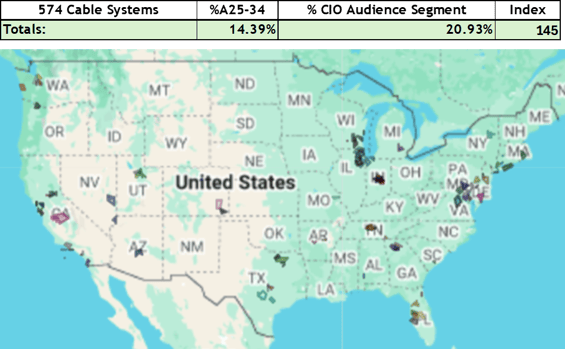
By ranking all 2,800 local cable systems and selecting the Top 574, we achieved an Index of 145. This represents 1.45x more CIOs than the national average for the same out-of-pocket cost.
High-Performing DMAs for B2B Targeting (CIOs)
Markets often overlooked by "top-tier" only strategies actually outperform the giants when evaluated through an audience lens:
- Washington, DC: Index 164
- Atlanta, GA
- Dallas-Ft. Worth, TX
- Tampa-St. Pete, FL
The Real Power Move: ZIP Code Precision
Let’s zoom in on the Washington, DC DMA. While the traditional DMA index is a strong 164, surgical targeting reveals even higher efficiency:
- The Stat: The top 10% of ZIP Codes in DC contain 41.1% of all CIOs in that market.
- The Result: A combined ZIP Index of 411 (4X concentration).
Pro Tip: Layering CTV (Connected TV) and direct mail onto these specific ZIP Codes creates a high-frequency, omnichannel "surround sound" effect for C-suite targets.
Traditional Washington, DC TV DMA Index = 164
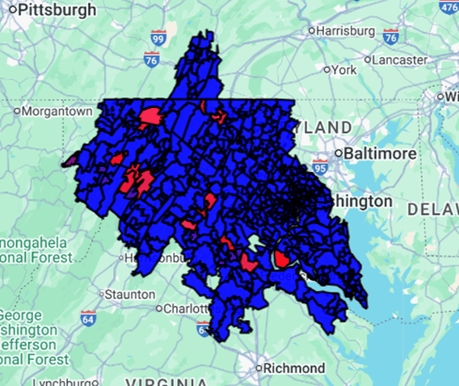
BONUS: 41.1% of CIOs live in the top10% of ZIP Codes in the Washington, DC area.
That is an outstanding combined ZIP Index = 411 (that’s 4X)
See map left, ZIPs highlighted in red.
MORE: A complementary CTV, digital and direct mail effort to these ZIP Codes can extend your reach.
How Tango Media Systems Solves the Unstructured Data Crisis
This level of precision is impossible without technology that can structure fragmented local TV inventory. The Tango suite provides the digital architecture for automated TV ad campaigns:
TangoGEO: Maps audiences across HH, ZIP, Cable, and DMA levels using private datasets.
TangoLINX & TangoRESPONSE: Structures and standardizes fragmented broadcast inventory and eliminates manual RFP processing.
TangoACT: Activates multimarket plans across 2,800 local cable systems simultaneously.
TangoREV: Closes the loop with Mediaocean and Strata integration for clean reporting.
Impactful Media Recommendations for 2026
Stop Buying "Waste": 80% of the U.S. audience is likely NOT your target. Focus spend on the top 20% of locations where your audience over-indexes.Build Custom National Geographies: Use all 210 DMAs + 2,800 cable systems to build a footprint based on audience density, not city size.
Layer ZIP-Level Targeting: Use data-driven linear TV in tandem with CTV to increase household precision.
Measure What Matters: Use cross-channel attribution to quantify how local TV presence drives digital lift and sales.
The Bottom Line
The biggest surprise in modern TV advertising isn’t just where your audience is—it’s how much budget is wasted assuming they are in the "Big 6" markets.
Precision beats scale. Higher impact doesn't require more spend; it requires better data.
Stop buying markets. Start buying linear TV audiences.
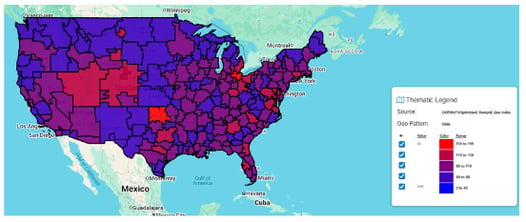
National analysis of DMA level concentrations show some surprise concentrations and not all in the top markets.
#B2BMarketing #DataDrivenMarketing #AudienceTargeting #Geotargeting #MediaPlanning #PrecisionMarketing #DataScience #CSuiteMarketing